
Searching LaPorte County Civil Dockets
Indiana MyCase is the main online route into a LaPorte County civil docket. It is also called Odyssey Public Access. Know the cause number? Search by Case Number. Otherwise use Party mode to look up a plaintiff, defendant, petitioner, respondent, individual, or company. Pick the Civil, Family, or Probate category that fits. Then filter by LaPorte County, court, case status, and filing dates. Attorney mode works with a lawyer's name or bar number.
Online search is one channel, not the whole path. Heather Stevens, Clerk of the Circuit Court, maintains the public-facing records. You can call the clerk or the court. You can also visit the counter that serves the court named in the cause number, or mail a focused written request. Four clerk offices serve five courts across two complexes. Confirm the counter before you travel. Give the court, cause number, case style, event date, and the exact document. Say whether you want a plain or certified copy.
- Open MyCase and select Case, Party, or Attorney search.
- Choose Civil, Family, or Probate and add county and date filters.
- Match the court code, case style, file date, and party roles.
- Read service, filings, settings, orders, and the latest disposition.
- Ask the maintaining clerk for an official or missing record.
LaPorte County Civil Docket Filters
Filters keep a broad name from returning a useless list. A cause number starting with 46C01 belongs to Circuit Court. The four Superior Courts carry codes 46D01 through 46D04. Party mode covers people and businesses alike. A filing-date range helps when a name is common. The start date must fall before the end date. One caution: a public attorney result does not prove current representation. Scan the later appearance and withdrawal entries before relying on it.
| Search need | MyCase control | Reading check |
|---|---|---|
| Known civil cause | Case Number | Match the 46C01 or 46D court code |
| Person or business | Party | Confirm the role and case style |
| Case family | Civil, Family, or Probate | Read the exact case-type code |
| Counsel | Attorney | Check later appearance entries |
| Filing period | File Date Start and End | Use a valid date sequence |
A document link opens only when that record type is offered remotely. Running the search again will not surface an excluded or unlinked filing. For that, the clerk is your next stop.
Inside a LaPorte County Civil Docket
The header gives you the frame. It holds court, cause number, file date, case type, case style, status, and status date. Party fields then label each plaintiff, defendant, petitioner, respondent, intervenor, guardian, or other role. The Chronological Case Summary, or CCS, lists events in date order. Those events can run from complaint or petition, summons, and return of service. They continue through appearance, answer, counterclaim, motion, order, hearing notice, continuance, and mediation. They extend on to trial, judgment, satisfaction, appeal, and closure.
| Header | Court, cause number, type, style, status, and filing date |
|---|---|
| Parties | Named roles and public attorney or representation details |
| Service | Summons, delivery attempt, return, and related dates |
| Chronology | Filings, motions, orders, settings, judgment, and closure |
| Settings | Date, time, location, judge, hearing type, and reset history |
| Financials | Costs, service fees, judgment amount, payments, and balance |
| Cross references | Related, transferred, companion, or appellate causes |
One key distinction: a docket entry is not the filed document. The CCS may show a motion or order exists even with no image attached. Ask the clerk for that exact item. Confirm current balances and certified judgments there too.
LaPorte County Civil Docket Allocation
LaPorte County splits its civil work among courts. Under the local caseload rule, Circuit Court, Superior Court 1, and Superior Court 2 take new filings in probate, protective orders, dissolution, paternity, custody, support, and general-jurisdiction matters. Superior Court 3 is the county's most visible route for civil claims and small claims. Superior Court 4 handles civil and small-claims work as well.
The official Superior Court 1 source shows the Michigan City court and its civil context.
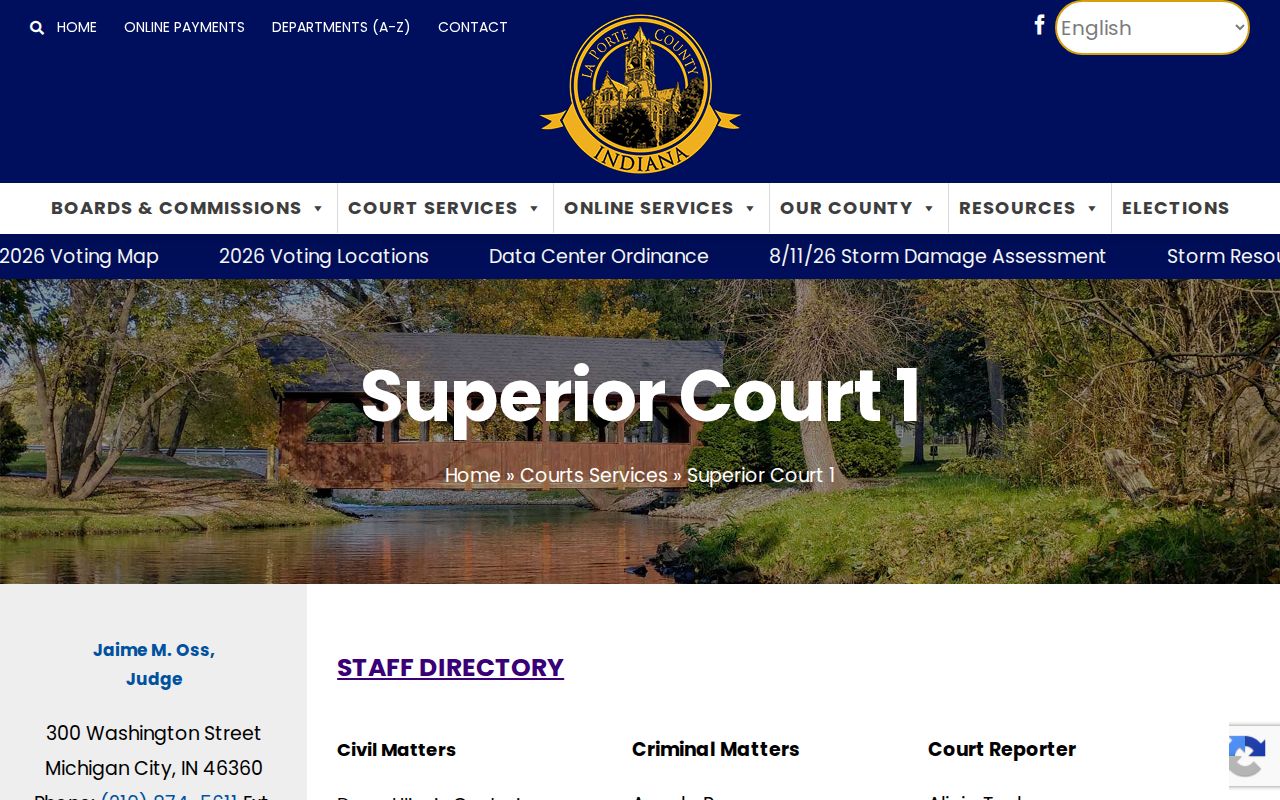
That source reinforces a vital search rule. A civil matter may sit in a different general-jurisdiction court than you first expect, because the county's transfer and processing rule defeats easy guesses. So skip the assumption and follow the cause-number court code instead.
Civil Case Types on the Docket
Civil is really several docket families in LaPorte County. PL means plenary, the broad civil claim. MF marks mortgage foreclosure, CC collection, CT tort, and SC small claims. For family matters, DR covers domestic relations, DC a case with children, and DN one without. Probate codes include ES for estate, EU for unsupervised estate, GU for guardianship, and TR for trust. PO flags a protective-order case.
- General claims, collections, torts, and mortgage foreclosures
- Small claims and eviction matters
- Dissolution, custody, support, and paternity cases
- Estates, trusts, and guardianships
- Protective orders, tax matters, and other petitions
Read the code first, then the party roles and events. Petitioner and respondent show up in family or probate work, while plaintiff and defendant fill other claims. Also expect a public case shell around a private core: medical, treatment, child, financial-account, or evaluation records inside a case can be excluded.
LaPorte County Civil Docket Claims
Superior Court 3 posts its own civil-claim, fee, and small-claims information. It also states that e-filing is available. Superior Court 4 offers a parallel civil and small-claims route. Do not assume every small claim lands in one court. Match the cause number and caption first. Then trace the service, appearance, default, judgment, and payment entries within that case.
The official Superior Court 3 source lays out that local route.
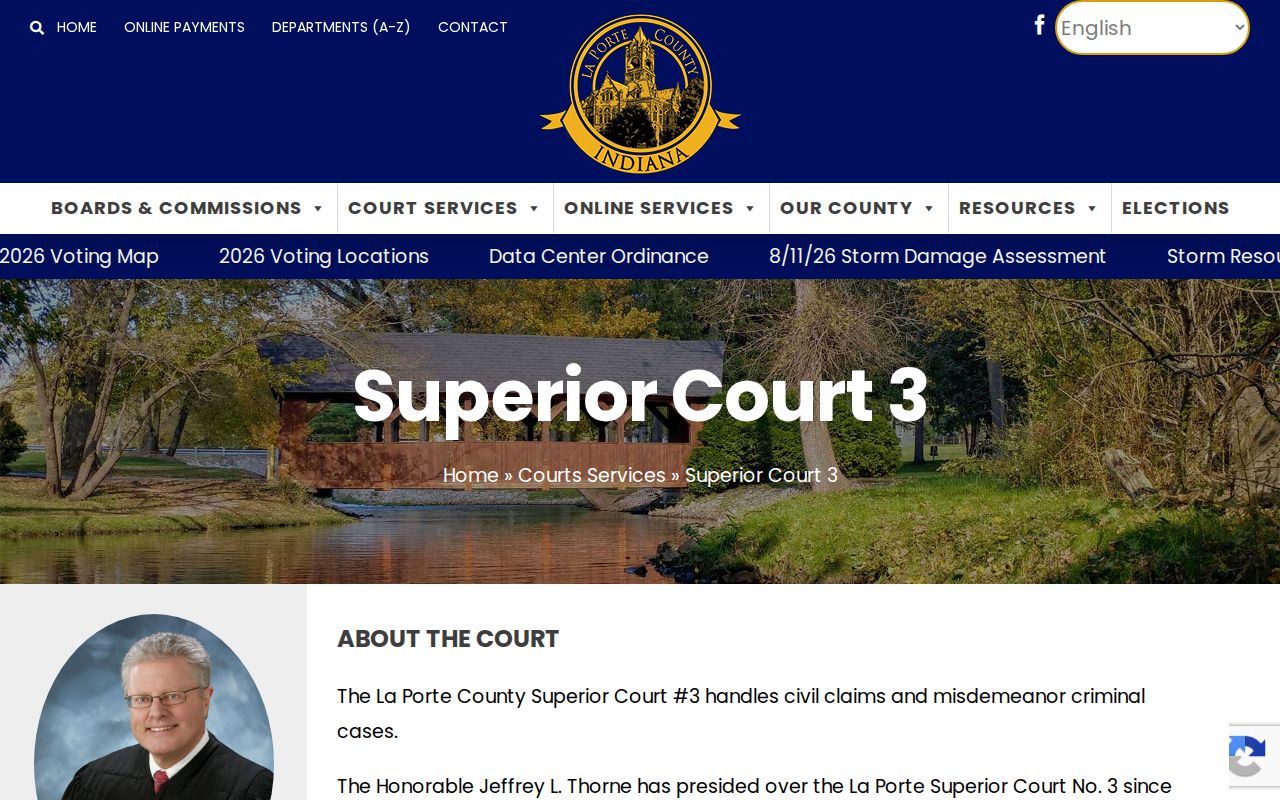
The source ties the public docket to the court holding the file. Indiana's E-Filing System feeds the Odyssey case environment, and attorneys must e-file in LaPorte County. Even so, an electronic filing can still need clerk processing before the public CCS shows it.
Civil Docket Settings and Hearings
A LaPorte County civil docket lists settings of many kinds. They include motion hearings, status conferences, pretrial conferences, civil call, mediation, bench trials, and jury trials. The setting type matters. So does the order that created it. A status date, for instance, is not automatically a trial date. Service deserves the same care. Before reading a default entry, check the docket. It should show the summons or notice path and its return.
A continuance or reset simply moves a scheduled event. When dates conflict, trust the later signed order. Trust the newest CCS setting over any old notice. Compare the date, time, courtroom, judge, and setting type each time. A public stream lets you observe a hearing. It is not a case archive or proof of any result. The LaPorte County court dates page covers the related calendar route.
When a setting changes: read the newest entry, locate the reset order, and confirm the current date with the coordinator or clerk for that court.
LaPorte County Civil Docket Costs
LaPorte County's court-cost sheet carries an effective date of July 1, 2021. Treat its figures as historical, and confirm current amounts with the clerk. Under that schedule, PL, CC, CT, MF, MI, and AD filings cost $157. Dissolution cases coded DC or DN run $177, which includes a $20 alternative-dispute-resolution fee. Probate filings under ES, EU, TR, and GU also list at $177. Juvenile paternity JP is the highest at $196. The same stated ADR component is built in.
| County sheet category | Listed filing amount | Related line |
|---|---|---|
| PL, CC, CT, MF, MI, AD | $157 | $10 per added defendant for a pro se filer |
| DC or DN dissolution | $177 | Includes $20 ADR fee |
| ES, EU, TR, GU probate | $177 | Sheriff service listed separately |
| JP paternity | $196 | Includes $20 ADR fee |
| SC small claims | $87 county line; $97 pro se | Added-defendant and service lines may apply |
The same sheet lists sheriff service at $28 across several categories. Certified mail for a dissolution case shows $6.94. Those are historical schedule figures, not today's total. Ask the clerk for the current amount and the accepted service method before you file or pay.
Civil Docket Access Rules
Indiana Access Rule 4 sets the baseline for general public access. Access Rule 5 then carves out whole cases, documents, and data. A public civil shell may show an excluded-record indicator while revealing nothing behind it. Medical records, treatment material, account details, protected-person data, custody evaluations, and certain child-related records can all be restricted. This is how the rule applies to them.
Public case, restricted filing: The visibility of a case summary does not make every document remotely available. A missing link calls for a clerk inquiry, not repeated searching.
Indiana Administrative Rule 9 governs authorized remote access, daily calendars or dockets, and related fees. Indiana Code 5-14-3 supplies the broader Access to Public Records Act framework. Supreme Court rules still control court records. An extraordinary verified request under Access Rule 9 is a separate animal. It is not an ordinary copy request, and it guarantees nothing.
The Indiana judiciary source for proposed 2026 problem-solving court rules records a recent statewide policy development. It touches restricted program material.
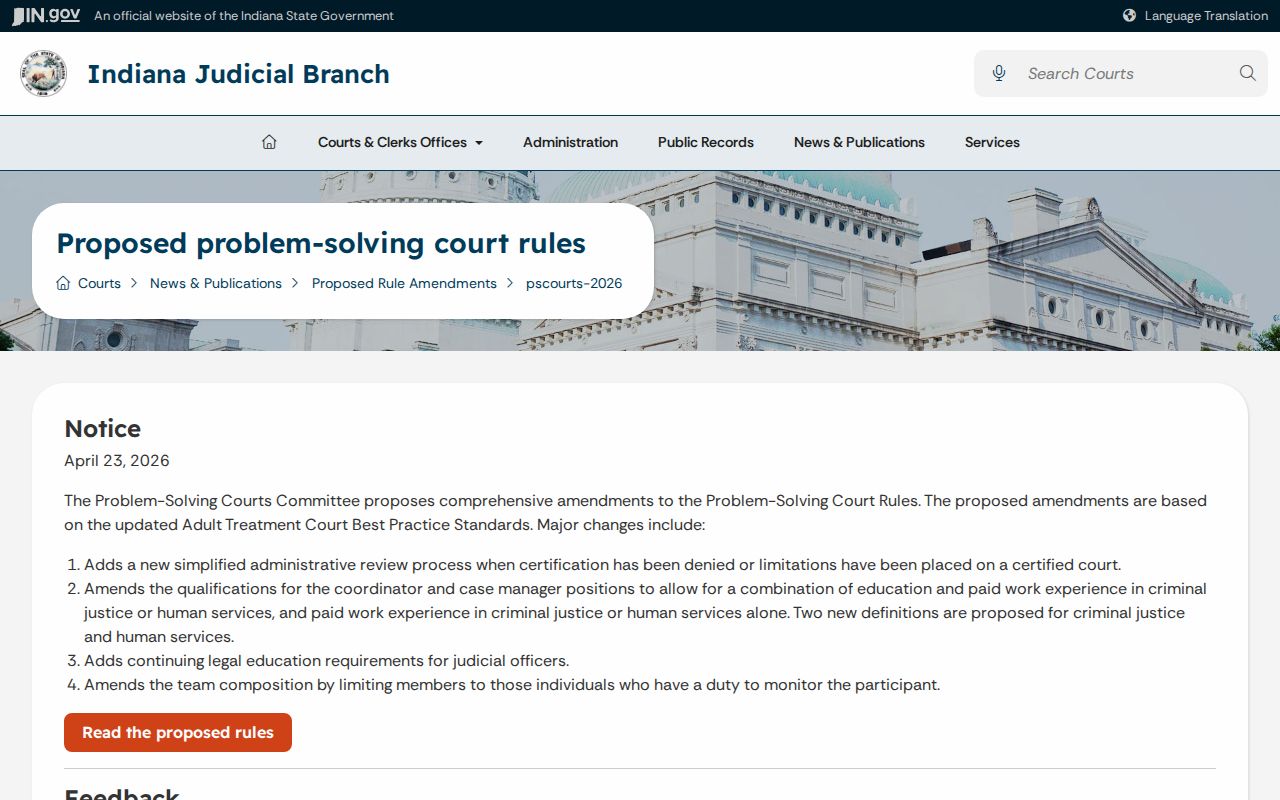
The proposal would not convert treatment or supervision records into ordinary public civil docket material. Current access rules and the court's own order still control each record.
LaPorte County Civil Docket Outcomes
Read a LaPorte County civil docket as a sequence, never as one status word. Start with the category and the party roles. Then trace the complaint or petition, service, appearance, answer, motions, orders, settings, trial or hearing, judgment, satisfaction, appeal, and closure. A default means the court entered an outcome after a required response or appearance failed. By itself it explains no service details, damages, later relief, or payment.
Dismissal, judgment, transfer, and satisfaction each describe a different event. A transfer can change the court code. Cross references between the old and new causes may still remain. A judgment decides rights or an amount. A satisfaction or release records a later development. Read the linked order whenever one exists. For the official judgment, petition, transcript, or current balance, ask Heather Stevens. She is Clerk of the Circuit Court, and she keeps the maintained record. MyCase itself warns that its public display is not the official court file.